

Work Through What Keeps You Stuck
 No one escapes life without some trauma. It shows up in sexual, physical, and emotional abuse, neglect, medical trauma, natural disasters, domestic violence, terrorism, school shootings, and traumatic loss. What traumas have in common is overwhelming fear due to a threat to survival for yourself or others. Trauma is not defined by the event itself, but by your response to the event. That is why people can be exposed to the same trauma and have different responses. For some an event is frightening, but not overwhelming and becomes just another memory of the past. Yet for others, it alters the brain and nervous system in ways that continue to shape future experiences in powerful and predictive ways.
If you have struggled with abuse of substances or addictive behaviors and never connected the dots to trauma, it will offer you a powerful new lens to understand the origins, development, and consequences of addiction. Even more, it will offer you hope that by addressing trauma you can overcome addiction in your life.
-
Types of Trauma
To get started assessing trauma, use the following form (PDF) that lists different types of traumas and consider whether each type has happened to you and its impact on your life.
-
Adverse Childhood Experiences
Another way to explore the degree to which trauma impacts your life is by assessing adverse childhood experiences, or ACEs. To learn more about ACEs and take a brief assessment that provides you an ACE score, check out:
-
Post Traumatic Stress Disorder (PTSD)
In this program we are not focused on “diagnoses” of mental or emotional challenges, which are done by healthcare professionals. That said, when trauma symptoms are significant, they can result in a diagnosis of Post-Traumatic Stress Disorder (PTSD) that can benefit from expert treatment. The tool below is a brief screen for PTSD, and if positive, may or may not mean you have PTSD. If you have questions or concerns about the results please contact one of our trained clinicians at NMCAL.
 Healing ACEs and Trauma
 4 Tools to Self-Treat Trauma
 Parts Work
 Mental Health One-Stop Shopping
 Developmental Catch-up
 Grief Work
 Addressing Trauma and Addiction (Community)
 Embracing Your Internal Family
 Growing Up Emotionally: Living from Your Head & Heart
 Attachment
 ACE Study
 Trauma 101
 Fight, Flight, Freeze
 Your Brain on Trauma
 What You Can’t Remember
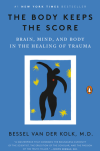
Bessel van der Kolk, MD
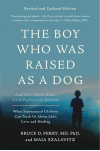
The Boy Who Was Raised as a Dog
Bruce D. Perry, MD, Ph.D. &
Maia Szalavitz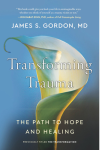
James S. Gordon, MD
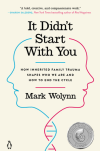
Mark Wolynn
Richard Schwartz, Ph.D.
Peter A. Levine, Ph.D.


